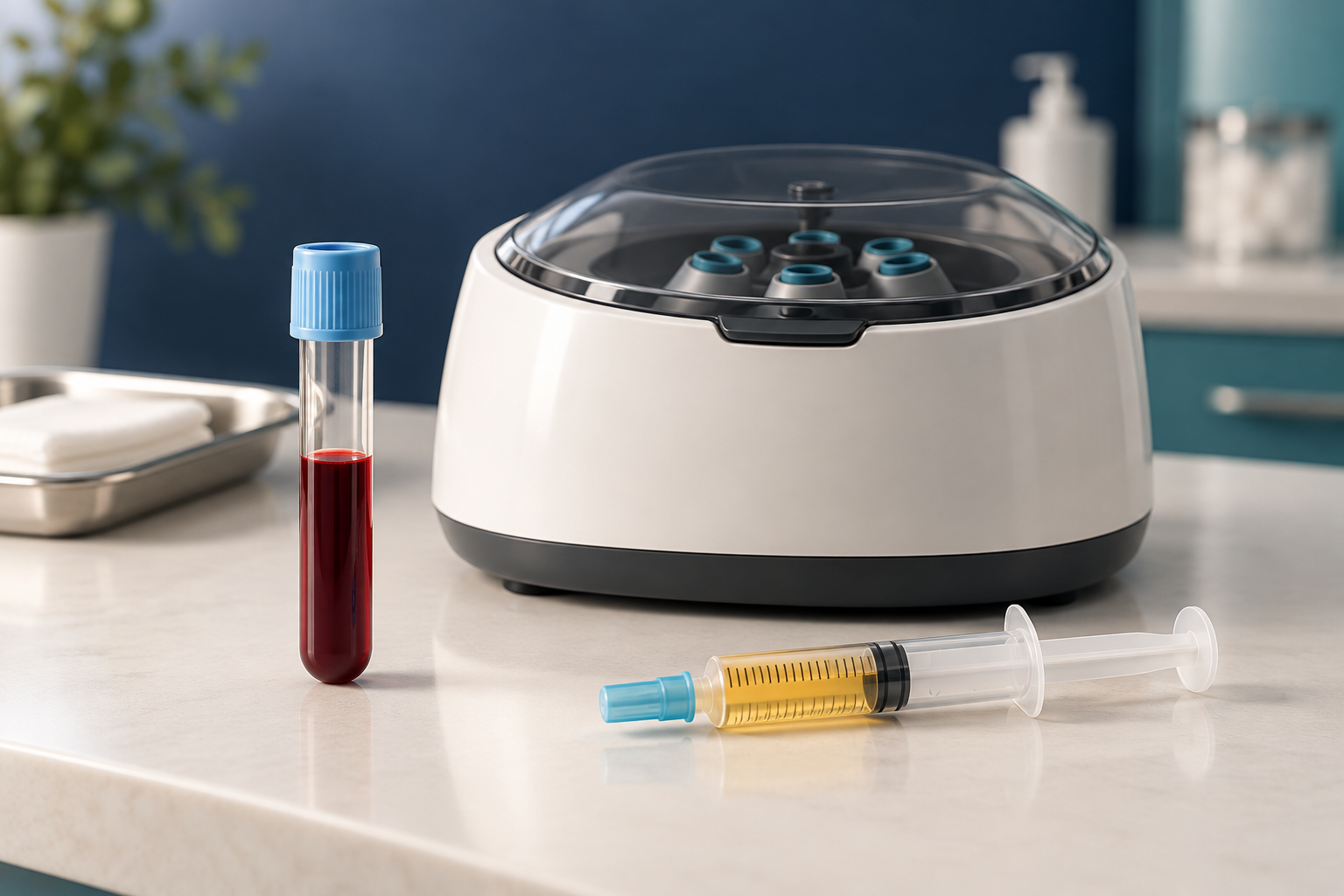
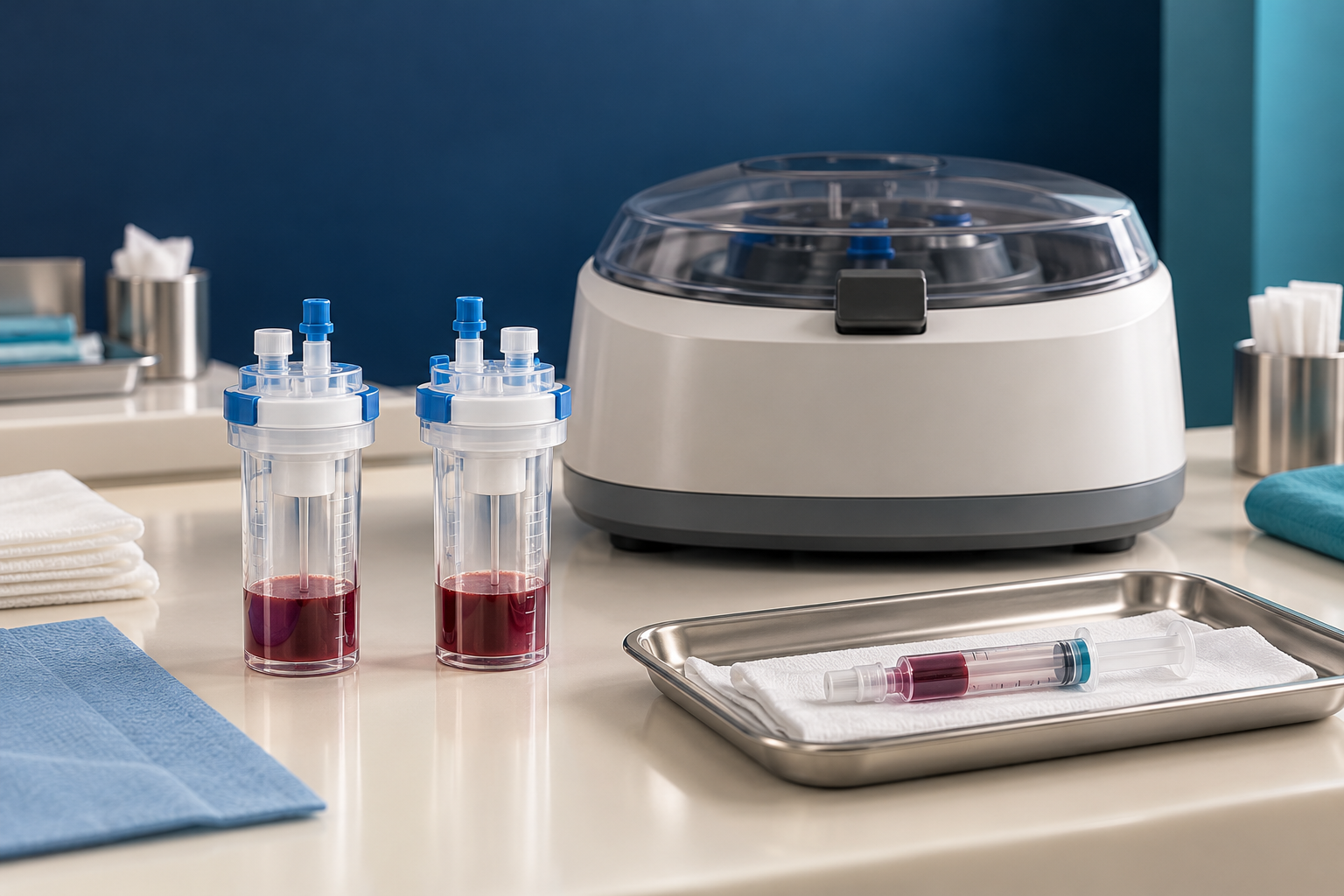
Platelet rich plasma
PRP is prepared from the patient's blood. Evidence varies by condition and preparation. Important trials have not shown a benefit, and cartilage regrowth is not established.
Read Chapter 7 →
Joint and tendon care
A clear diagnosis, a realistic recovery goal and an informed discussion of treatment.
After your consultation
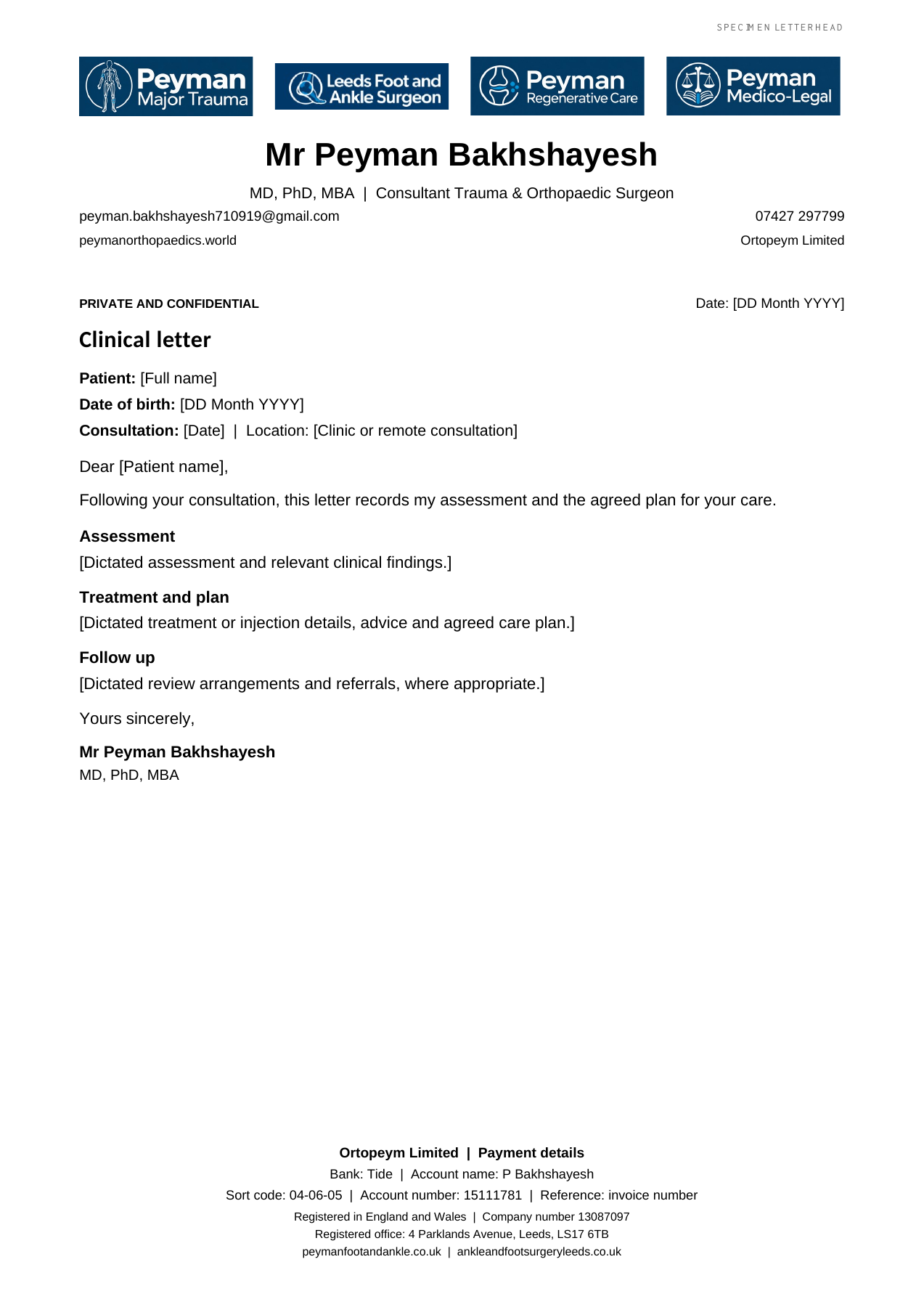
Immediately after your visit, you will receive a clinical letter by email on Mr Peyman Bakhshayesh’s practice letterhead. It will summarise the assessment, any treatment or injection provided, and the agreed plan for your care and follow-up. Please confirm your preferred email address at your appointment.
Practice correspondence: peyman.bakhshayesh710919@gmail.com
London Pain & Regenerative Clinic · London Private Ultrasound
Explore the London clinic's published treatment and assessment fees.
| Treatment or service | Price |
|---|---|
| Platelet-rich plasma (PRP) regenerative therapy | £699 |
| Corticosteroid (steroid) injection | £299 |
| Hyaluronic acid / hydrogel joint lubrication | £399 |
| Ultrasound-guided precision joint & tendon injection | £299 |
| Ultrasound-guided joint aspiration | From £299 |
| Diagnostic musculoskeletal ultrasound scan | £199 |
| Personalised rehabilitation & recovery programme | £299 |
Laboratory fluid analysis, combined injection treatment or treatment of multiple areas may involve an additional fee, explained before the procedure.
These are the London clinic's published prices. Confirm the exact product, treatment plan, availability and total fee with the clinic before booking. Fees at Huddersfield Private Hospital are confirmed separately.
Shockwave therapy (ESWT) and bone marrow aspirate concentrate (BMAC) are not priced on the linked London clinic page. Ask the practice about availability and an individual quote.
Mr Peyman Bakhshayesh offers orthopaedic assessment and treatment planning for joint and tendon symptoms. The consultation connects the diagnosis with rehabilitation, appropriate symptom treatments and a careful discussion of procedures.
Regenerative care includes treatments with different purposes and different levels of evidence. Improving pain or function does not necessarily mean that cartilage or tendon has regenerated. A treatment plan should explain the expected benefit, the uncertainty, the risks and the alternatives.
Whether a particular procedure is appropriate and available is confirmed after assessment. The book describes the wider field and is not a menu of procedures suitable for every patient.
Arrange a consultation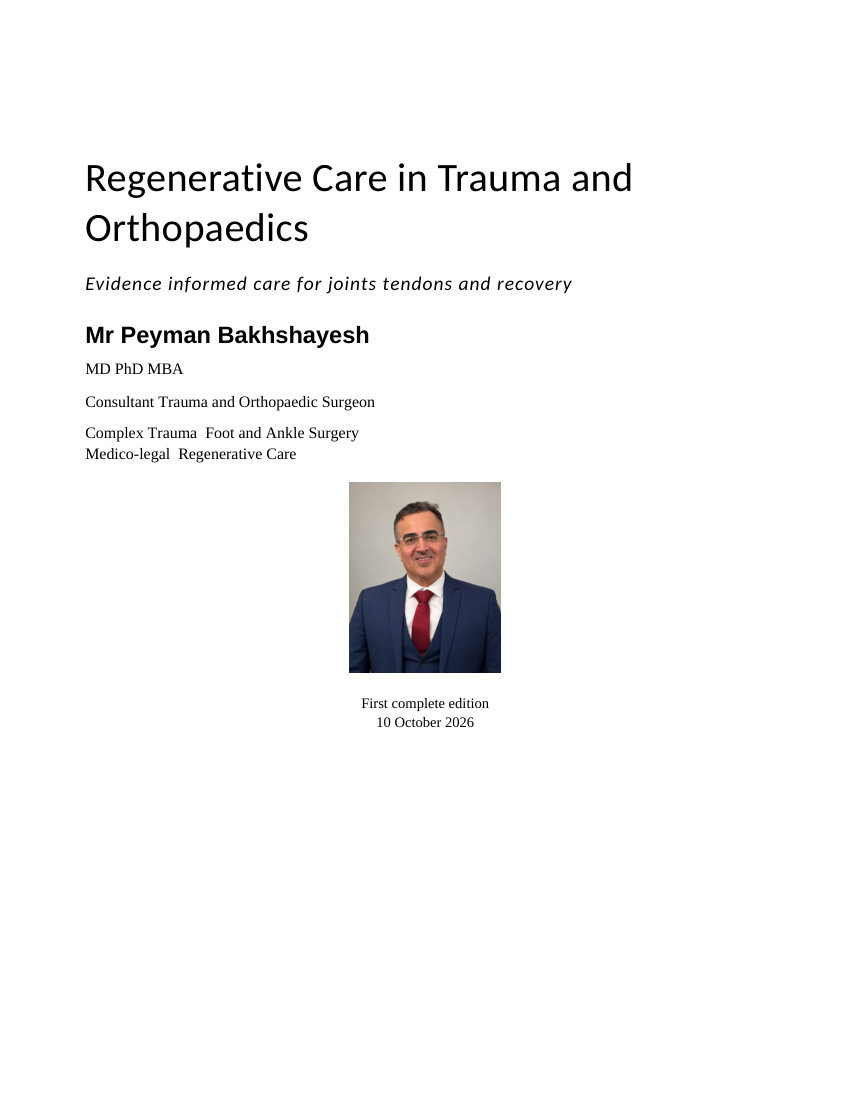
The complete book
Biology, mechanics and the recovery of function
By Mr Peyman Bakhshayesh, MD, PhD, MBA, Consultant Trauma and Orthopaedic Surgeon.
Educational information to support a consultation. It does not provide an individual diagnosis or prescription.
Treatment questions
PRP is prepared from the patient's blood. Evidence varies by condition and preparation. Important trials have not shown a benefit, and cartilage regrowth is not established.
Read Chapter 7 →A non-invasive procedure studied for selected tendon and heel symptoms. Its evidence is mixed and condition-specific; rehabilitation remains central.
Read Chapter 10 →Steroid may provide short-term symptom relief. NICE does not recommend hyaluronic acid for osteoarthritis. Hydrogel evidence and precautions are product-specific.
Read Chapters 5 and 6 →Bone marrow concentrate is not a purified stem cell product. Routine tissue regeneration has not been established, and product-specific regulation matters.
Read Chapter 8 →Progressive activity, strength and load management support recovery. The plan should fit the diagnosis, health, work and personal goals.
Read Chapter 18 →Understand alternatives, material risks, uncertain benefit, aftercare and when to seek urgent help before agreeing to a procedure.
Read Chapter 20 and the appendices →Inside the book
The linked bibliography includes current NICE guidance, primary studies and 2026 professional recommendations. It explains where guidance differs and where evidence remains uncertain.
NICE osteoarthritis guidance ↗
NICE PRP knee procedure guidance ↗
Private care in Huddersfield
Arrange an appointment to discuss your concerns and the options available to you.
Patient information & informed choices