New illustrated book · Free English PDF
Philosophy of Inter- and Subtrochanteric Fractures
Understanding the fracture. Restoring support. Planning recovery.
From fracture mechanics to the patient’s recovery
Intertrochanteric and subtrochanteric fractures demand an understanding of the injury, the person and the practical challenges of reconstruction. Mr Bakhshayesh brings together his surgical philosophy, experience and published evidence in nine illustrated chapters.
The book follows the pathway from epidemiology and classification to patient positioning, reduction, intramedullary fixation and multidisciplinary care. It also examines mechanical failure, revision choices and the outcomes that matter to patients.
Inside the book
- Introduction and the author’s clinical philosophy
- Epidemiology and the burden of injury
- Classification and treatment planning
- Traction table versus lateral positioning
- Reduction and fixation technique
- Positive medial calcar support versus anatomical reduction
- Follow-up: healing the person and the fracture
- Failure: patterns and assessment
- Outcomes and reconstruction after failure
Positioning, reduction and surgical judgement
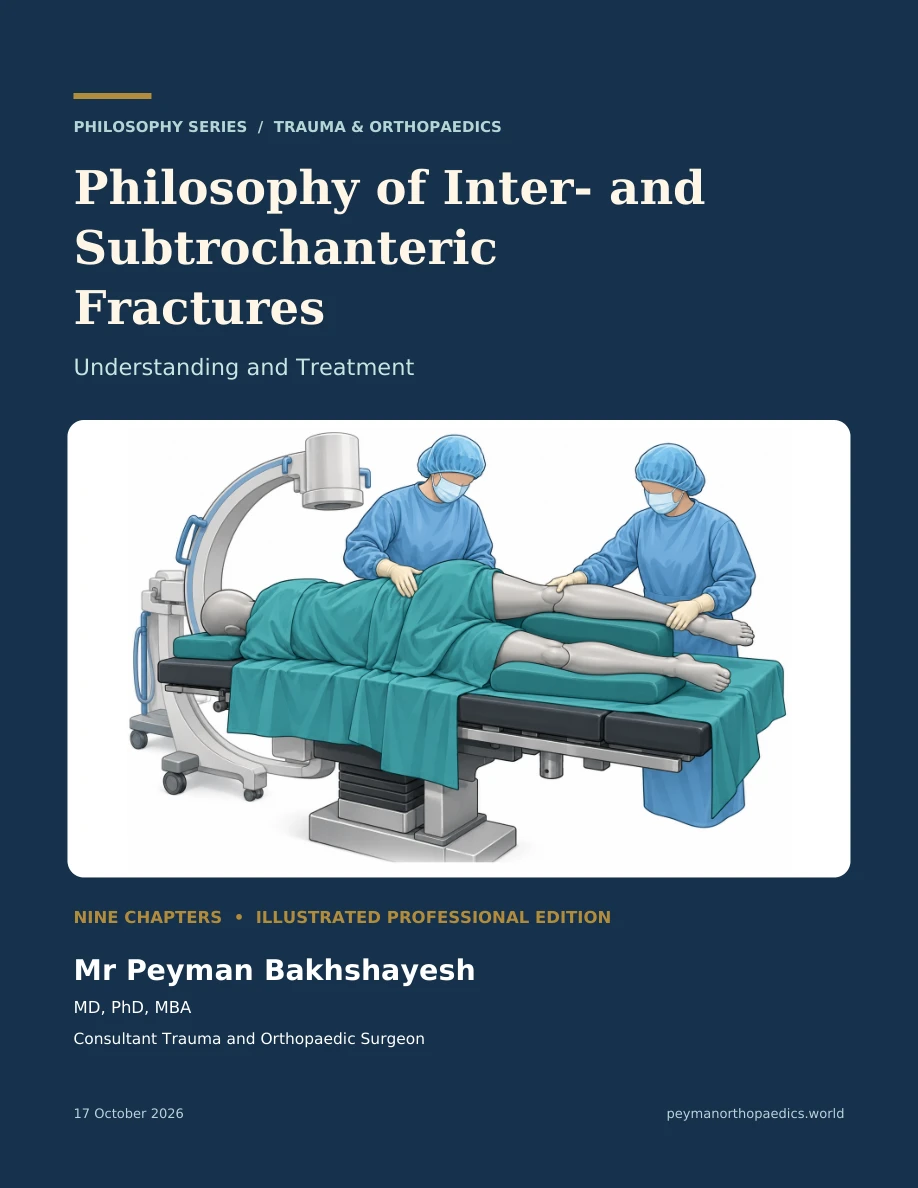
A central discussion compares the familiar traction-table approach with lateral positioning without continuous traction. The author explains his preference for the lateral position in selected highly unstable fractures, including the practical demands of reduction, imaging and maintaining alignment.
The chapter on positive medial calcar support examines its proposed mechanical role alongside anatomical reduction, cortical contact, sagittal alignment and implant placement. The discussion identifies the scope and limits of the available evidence and the importance of the individual fracture pattern.
Recovery, failure and meaningful outcomes
Successful treatment extends beyond the operating theatre. The book discusses frailty assessment, orthogeriatric care, nutrition, rehabilitation, discharge planning and the coordination of the clinical team.
Failure analysis covers loss of reduction, screw migration, implant breakage and other complications. Revision fixation, arthroplasty and other salvage procedures are considered in relation to bone stock, fracture healing, infection, function and the patient’s priorities.
Illustrated for teaching
Fictional illustrations explain positioning and operative concepts without reproducing identifiable patients. Teaching diagrams accompany the discussion of fracture patterns, cortical support and recovery.
The figures support the surrounding text and are schematic educational illustrations.
Related reading
Philosophy of Ankle Fracture Classification and Targeted Treatment →
About this edition
Written for clinicians, trainees and readers seeking a detailed understanding of proximal femoral fracture care. The author’s preferences and clinical reasoning are presented alongside referenced evidence. Treatment, postoperative loading and rehabilitation depend on individual assessment and the achieved stability of fixation.
This is the author’s professional educational publication. Institutional appointments do not imply endorsement by an employer, hospital or university.